
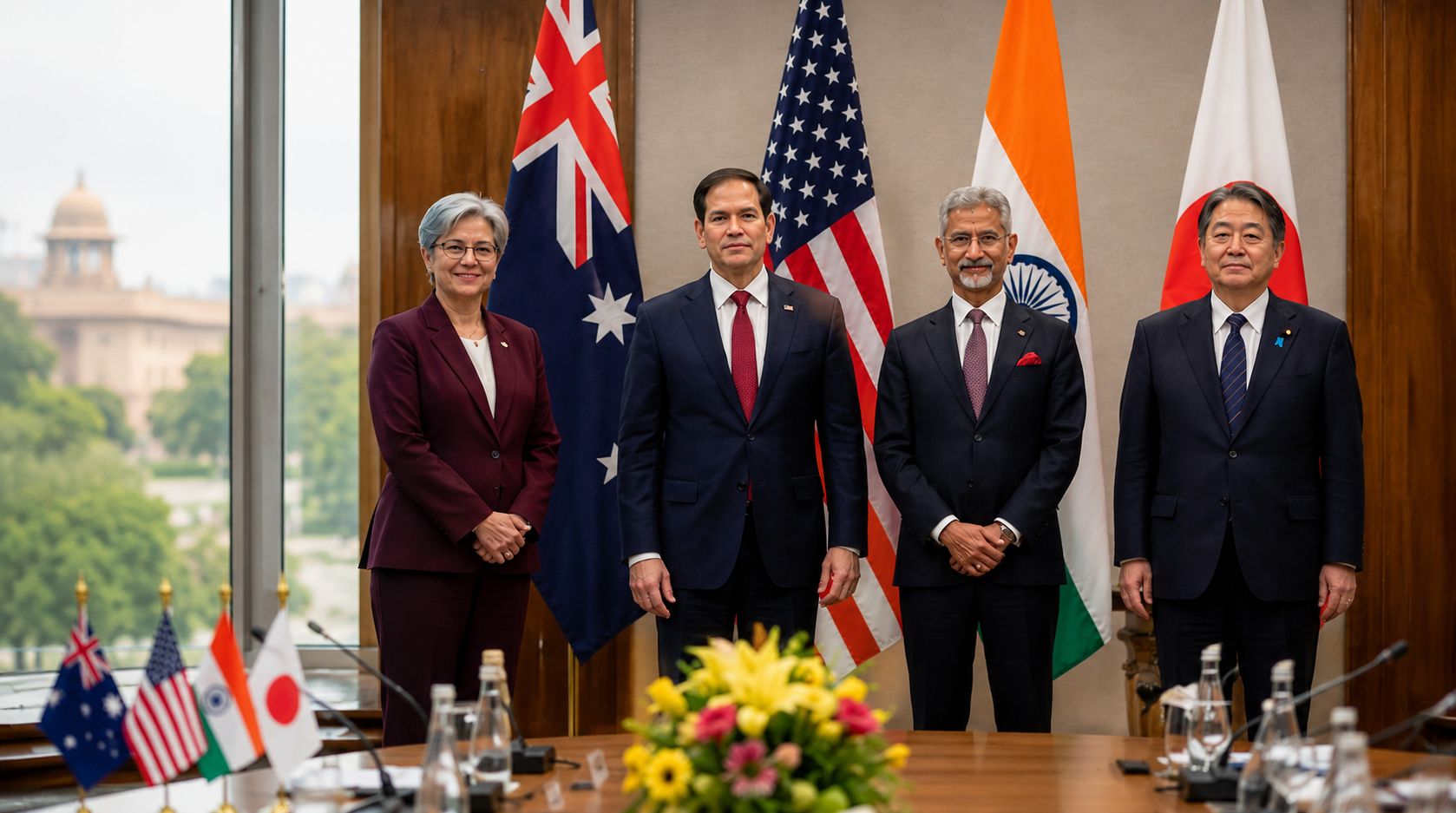
The Quad alliance made up of the United States, India, Japan, and Australia has announced a series of new initiatives focused on regional security, critical minerals, energy cooperation, and maritime surveillance across the Indo-Pacific.
During a meeting held in New Delhi, US Secretary of State Marco Rubio described the Quad as a “partnership of action” and emphasized that the group is moving beyond discussions toward concrete collaboration.
Rubio stated that the four nations have agreed on several practical initiatives that will strengthen cooperation in the region and improve long-term economic and security stability.
Shared Indo-Pacific Surveillance Initiative
One of the key announcements was a new surveillance cooperation plan designed to improve maritime awareness across the Indo-Pacific region. The initiative will allow the Quad nations to integrate their surveillance capabilities and share near real-time information on ship movements, including commercial shipping activity.
The move is expected to strengthen regional monitoring and support safer navigation in strategically important waters.
Focus on Energy Security
The Quad also introduced a new Indo-Pacific energy security initiative aimed at improving regional fuel supply chains and reducing vulnerabilities caused by global disruptions.
The announcement comes at a time when concerns around global energy stability are rising due to tensions in the Middle East and disruptions linked to the Strait of Hormuz.
Rubio confirmed that the United States will host a Quad Energy Security Forum later this year to further discuss regional energy cooperation and resilience.
Australian Foreign Minister Penny Wong also highlighted the importance of maintaining freedom of navigation in the Strait of Hormuz, warning that any restrictions or additional tolls on shipping routes could significantly impact regional energy security and economic stability.
Critical Mineral Framework Announced
Another major development from the meeting was the launch of a new Critical Mineral Framework.
The framework is expected to strengthen supply chains related to mining, processing, and recycling of critical minerals. These resources are essential for industries such as electric vehicles, batteries, semiconductors, and clean energy technologies.
According to US officials, greater coordination among Quad nations will help reduce supply chain vulnerabilities and improve long-term economic security.
Infrastructure Partnership in the Pacific
The Quad nations also announced plans to work with Fiji on upgrading port infrastructure in the Pacific Islands region.
This marks the alliance’s first joint infrastructure project and reflects the growing strategic importance of the Pacific region in global geopolitics.
Quad’s Growing Global Importance
The Quad alliance continues to gain significance as geopolitical competition in the Indo-Pacific intensifies.
Ahead of the meeting, Rubio reiterated that the United States views the Quad as a key pillar of its global strategy. The alliance is widely seen as an effort to balance China’s expanding influence across the region.
Together, the four Quad countries account for nearly 30% of global GDP and represent close to two billion people.
The latest announcements signal a stronger push toward regional cooperation, economic resilience, and security coordination as the Indo-Pacific becomes increasingly important in global affairs.