
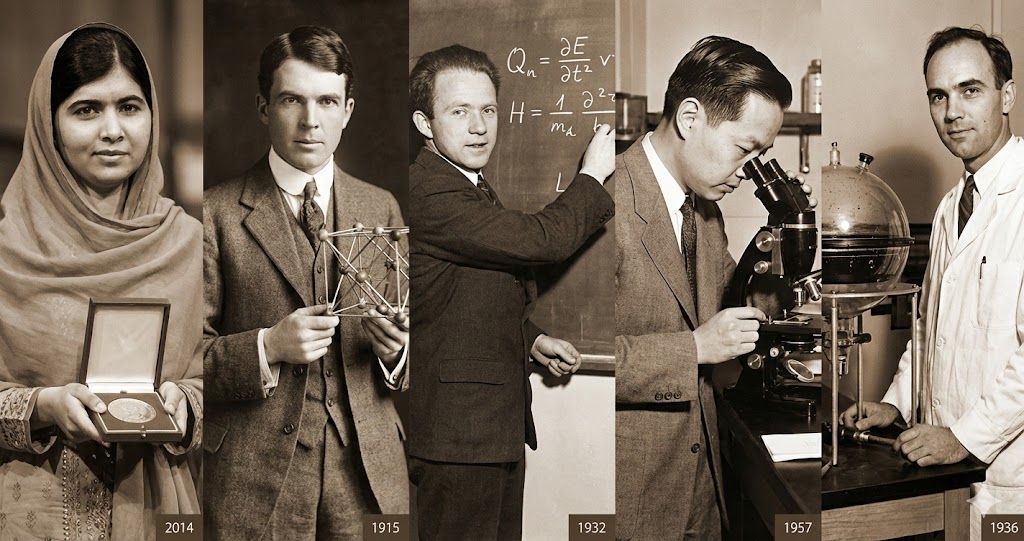
When we picture a Nobel Prize winner, we usually imagine a seasoned academic with gray hair, capping off decades of research with the ultimate accolade. It is, after all, the most prestigious honor on earth.
Yet, history is peppered with extraordinary exceptions—brilliant minds and courageous hearts who achieved global recognition before hitting mid-life. These individuals prove that revolutionary ideas and immense courage don’t require decades of experience.
Here are the top five youngest Nobel Laureates who defied expectations and shattered records.
1. Malala Yousafzai
Age at Award: 17
Category: Peace (2014)
It is hard to imagine a more deserving—or more youthful—recipient than Malala Yousafzai. In 2014, at just 17 years old, she shattered the record to become the youngest Nobel Laureate in history.
Awarded the Peace Prize alongside Kailash Satyarthi, Malala was recognized for her indomitable fight against the suppression of children and for the right of all young people to receive an education. Having survived a targeted assassination attempt by the Taliban in Pakistan simply for wanting to go to school, Malala turned personal tragedy into a global movement. She remains a powerful beacon of hope, proving that even a teenage voice can turn the tide against oppression.
2. Lawrence Bragg
Age at Award: 25
Category: Physics (1915)
Before Malala, William Lawrence Bragg held the record for youngest laureate for nearly an entire century, and he remains the youngest science winner ever.
In 1915, at the age of 25, Bragg won the Nobel Prize in Physics, an honor he shared with his father, William Henry Bragg (the only father-son team to win jointly). Their groundbreaking work was on X-ray crystallography. Put simply, they developed a method using X-rays to “see” the atomic structure of matter. This technique became foundational for future breakthroughs in chemistry and biology, including the eventual discovery of the structure of DNA.
3. Werner Heisenberg
Age at Award: 31
Category: Physics (1932)
Werner Heisenberg was awarded the 1932 Nobel Prize in Physics at age 31 (though he officially received it in 1933). He is celebrated as one of the true architects of quantum mechanics.
At a remarkably young age, Heisenberg developed ideas that fundamentally upended classical physics. He is best known for the “uncertainty principle,” which states that you cannot simultaneously know the exact position and momentum of a particle. His theoretical work reshaped our understanding of reality at the subatomic level and laid the groundwork for vast swaths of modern technology.
4. Tsung-Dao Lee
Age at Award: 31
Category: Physics (1957)
In a field often dominated by established dogmas, youthful audacity is sometimes required to break the rules. In 1957, at age 31, Tsung-Dao Lee shared the Nobel Prize in Physics with his colleague Chen Ning Yang for doing just that.
These young theorists dared to challenge a foundational idea of physics known as the “law of conservation of parity.” Their brilliant insights led to experiments proving that at a subatomic level, nature does not always behave symmetrically. Their ability to question deeply held assumptions transformed particle physics.
5. Carl Anderson
Age at Award: 31
Category: Physics (1936)
Rounding out the list is another 31-year-old physics prodigy. Carl David Anderson won the Nobel Prize in 1936 for a massive experimental breakthrough: the discovery of the positron.
The positron is essentially the “anti-electron.” Anderson’s work provided the first empirical proof of the existence of antimatter, confirming complex theories about the universe previously laid out by others. His discovery opened an entirely new door into high-energy physics.
Final Thoughts: When Youth Meets Brilliance
The stories of these five laureates remind us that innovation, intelligence, and courage are not bound by age.
Whether facing down armed oppressors to demand an education like Malala, or staring into the subatomic void to rewrite the laws of nature like Heisenberg and Bragg, these visionaries possessed a clarity of purpose that transcended experience. They serve as a timeless reminder that sometimes, it takes youthful energy and fearless thinking to change the world.
 Babita Jangra
 Jeel Patel