

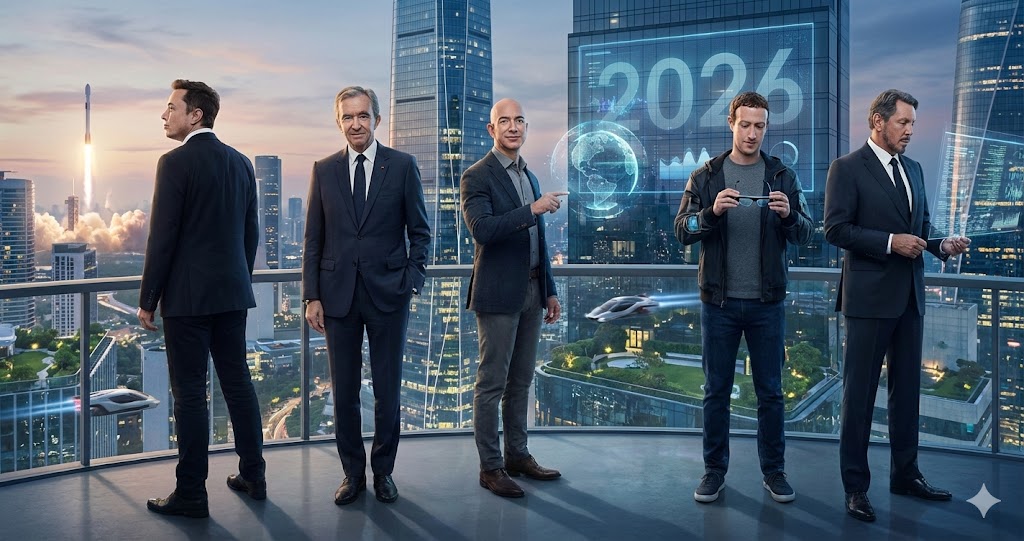
As we settle into 2026, the landscape of extreme wealth has continued to shift upward, driven by unprecedented advancements in artificial intelligence, space exploration, and global infrastructure. The “centibillionaire” club is no longer an exclusive rarity; it is the baseline for entry into the top tier of global finance.
The individuals on this list haven’t just ridden waves of economic growth; they have generated them. Their journeys are studies in resilience, almost precognitive strategic vision, and an absolute refusal to accept the status quo. In this article, we examine the lives and strategies of the five wealthiest individuals on the planet as of early 2026, exploring how they secured their places at the apex of the global economy.
Key Takeaways
- The AI Multiplier: Discover how nearly every individual on this list leveraged the mid-2020s artificial intelligence boom to exponentially increase their net worth.
- Diversification vs. Focus: Analyze the difference between those who built vast conglomerates versus those who dominated a single, world-changing vertical.
- Beyond Business: Understand how their hyper-wealth is funding private space races, radical philanthropy, and shaping geopolitical landscapes.
- The New Guard: Witness the shifting of the ranks as traditional finance icons give way to leaders in deep tech and data infrastructure.
1. Elon Musk: The Engineer of the Future
Reshaping Humanity’s Horizon
In 2026, Elon Musk remains the archetype of the volatile, visionary innovator. His net worth is highly reactive to the market performance of his varied interests, but his holdings in Tesla, SpaceX, and X.AI keep him firmly at the top. He is no longer just disrupting industries; he is actively attempting to ensure humanity’s long-term survival.
From Orbit to Autonomy
While Tesla faces stiff global EV competition, its strides in fully autonomous driving software have maintained its massive valuation. However, it is SpaceX’s dominance in orbital launch infrastructure and the Starlink global communication network that has provided the most formidable moat around his fortune.1 Musk’s wealth is now tied not just to cars on the road, but to the infrastructure of space itself.
2. Bernard Arnault: The Emperor of Exclusivity
The Immutable Value of Luxury
Bernard Arnault is the striking exception in a top five dominated by technologists. As the architect of LVMH (Moët Hennessy Louis Vuitton), he proves that heritage, craftsmanship, and the psychology of desire are recession-proof. Arnault’s genius lies in realizing that while technology changes rapidly, the human desire for status and exclusivity does not.
Artistry Meets Aggressive Strategy
Arnault is a ruthlessly effective businessman with the soul of an art patron.3 By consolidating nearly all of the world’s premier heritage brands under one umbrella from Tiffany & Co. to Christian Dior he controls the global luxury narrative. His ability to maintain the aura of scarcity while operating at massive scale is the key to LVMH’s enduring massive market capitalization.
3. Jeff Bezos: The Architect of the Modern World
The Infrastructure of Everything
Jeff Bezos may have stepped back from day-to-day operations at Amazon years ago, but his creation is more central to daily life in 2026 than ever before. He transformed Amazon from a “worrying” bookstore into the logistics and technological backbone of the modern world.4
AWS and the AI Backbone
While Amazon’s e-commerce arm is vast, Bezos’s enduring wealth is largely powered by Amazon Web Services (AWS).5 As the AI revolution of the 2020s required unprecedented computing power, AWS provided the cloud infrastructure that made it possible.6 Furthermore, his heavy investments in Blue Origin are beginning to pay off as the commercial space sector matures alongside Musk’s SpaceX.
4. Mark Zuckerberg: The Metaverse and AI Titan
The Great Pivot
Mark Zuckerberg’s return to the top echelon of wealth is one of the great business comeback stories. After facing intense scrutiny and scepticism in the early 2020s over his “Metaverse” bet, Zuckerberg’s aggressive pivot toward Artificial Intelligence paid massive dividends.
Owning the Next Interface
By heavily investing in open-source AI models (like the LLaMA series) and integrating AI deeply into Meta’s massive social platforms (Facebook, Instagram, WhatsApp), he revitalized the company’s ad engine. Furthermore, as spatial computing hardware finally matured by 2026, Meta’s early investments placed them at the forefront of the next major computing interface.
5. Larry Ellison: The Data Visionary
The Resurgence of Oracle
Larry Ellison, a titan of the original dot-com era, saw his net worth explode in the mid-2020s.7 While many wrote Oracle off as a legacy tech company, Ellison shrewdly positioned the company’s cloud infrastructure to specifically cater to the massive training needs of generative AI companies.
The Value of High-Performance Compute
Ellison recognized early that data would be the oil of the 2020s, and the refineries needed to process that oil were high-performance cloud centers. By forging key partnerships and focusing on enterprise-grade AI infrastructure, Ellison ensured that a significant portion of the AI boom flowed through Oracle servers, catapulting him back into the top five.
Conclusion
The roster of the top 5 richest people in 2026 tells a clear story: we are firmly in the grip of the “Deep Tech” era. With the notable exception of Bernard Arnault’s mastery of luxury, astronomical wealth is now almost exclusively generated by those who control the foundational platforms of the future AI, cloud computing, space access, and global data.
The stories of Musk, Arnault, Bezos, Zuckerberg, and Ellison are not just tales of money; they are narratives about individuals with the power to unilaterally direct the course of technological and cultural evolution.





Leave a Reply