
Key Takeaways
- The Perseid meteor shower 2026 offers 90-150 meteors per hour under a new moon, according to EarthSky (2026).
- The Geminid meteor shower 2026 peaks with a 21% waning crescent moon, providing nearly optimal dark skies, notes EarthSky (2026).
- Geminids are unique, originating from Asteroid 3200 Phaethon, not a comet, as highlighted by The Planetary Society (2026).
- Orionids, debris from Halley’s Comet, peak October 21-22, 2026, with an 80% moon setting after midnight, according to NASA (2026).
- For the Lyrid meteor shower 2026, a 27% waxing crescent moon sets after midnight, minimizing light interference, states EarthSky (2026).
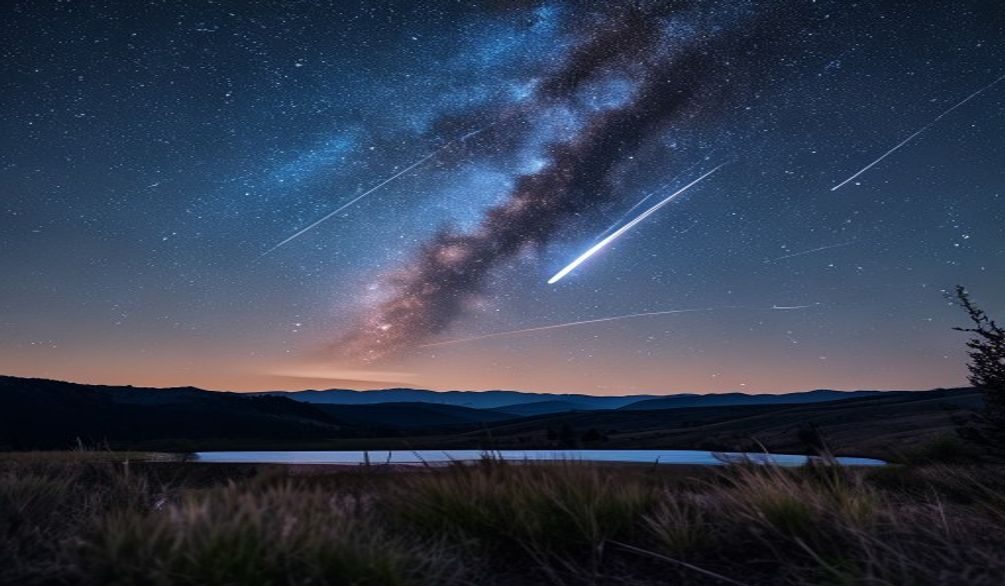
Are you ready to witness celestial fireworks without any special equipment? Discovering the Best Meteor Showers Naked Eye 2026 is easier than you think, offering breathtaking cosmic displays right from your backyard. This guide will help you pinpoint the top five stunning events and provide all the essential tips to maximize your naked-eye viewing experience.
Quick Answer: The top 5 stunning meteor showers visible to the naked eye in 2026 are the Perseids (August), Geminids (December), Lyrids (April), Orionids (October), and Leonids (November). These offer impressive displays with optimal viewing conditions under dark skies.
What Makes the Best Meteor Showers Naked Eye 2026 So Special?
The Best Meteor Showers Naked Eye 2026 are distinguished by their high Zenithal Hourly Rate (ZHR) and favorable moon phases, ensuring maximum visibility without optical aid. A new moon or a moon that sets early allows for a truly dark sky, which is crucial for spotting fainter meteors, according to EarthSky (2026).
These conditions are essential because moonlight acts as significant light pollution, washing out meteors that would otherwise be visible. Alan MacRobert of Sky & Telescope emphasizes that “Of all the different celestial sights visible around the year, meteor showers especially seem to captivate public interest” (2026). The predictability of these events, when combined with optimal moon phases, creates truly stunning natural light shows.
The allure of seeing shooting stars 2026 dates back centuries, and the experience is often more profound when witnessed directly.
For a meteor shower to be considered among the Best Meteor Showers Naked Eye 2026, several factors converge:
- High ZHR: This indicates the number of meteors an observer might see per hour under perfect, dark-sky conditions.
- Dark Skies: Minimal light pollution and a new moon or a moon below the horizon are paramount.
- Bright Meteors: Some showers are known for producing particularly brilliant fireballs or persistent trains, enhancing naked-eye visibility.
- Reliability: Consistent performance year after year, offering a dependable spectacle.
The upcoming year offers several excellent opportunities for naked eye astronomy 2026, making it a prime time for skygazers.

How to See Meteor Showers Without a Telescope: Your 2026 Guide
Seeing meteor showers without a telescope primarily requires dark skies, patience, and allowing your eyes to fully adapt to the darkness. The key is to find a location away from city lights, as urban light pollution can reduce visible meteors by 90% or more, according to The Planetary Society (2026). Your naked eyes offer the widest field of view, which is ideal for catching meteors that can appear anywhere in the sky.
To effectively watch meteor showers without a telescope, you need to allow at least 20-30 minutes for your eyes to adjust to the low light conditions. This adaptation period is critical for your pupils to dilate and your rods to become sensitive enough to detect faint streaks of light. Even a quick glance at a phone screen can reset this process, so use a red-light flashlight if illumination is needed.
Finding a spot with minimal light pollution is the single most important factor for observing the Best Meteor Showers Naked Eye 2026.
Here’s a practical guide on how to watch meteor showers without a telescope:
- Escape Light Pollution: Drive at least an hour outside major cities to reach genuinely dark sky viewing tips.
- Check the Moon Phase: Always prioritize nights with a new moon or when the moon sets early, as moonlight significantly interferes with viewing.
- Dress Warmly: Even on summer nights, extended periods of inactivity under clear skies can get chilly.
- Bring Comfort Items: A reclining chair, blanket, and a thermos of a warm drink will enhance your experience.
- Look Up (but not directly at the radiant): While meteors appear to originate from a radiant point, looking slightly away (about 30-45 degrees) can help you see longer, more impressive streaks.
- Be Patient: Meteors come in bursts and lulls; stay out for at least an hour for the best chance of seeing multiple events.
The best viewing meteor showers tips often involve simply lying down and scanning the entire sky, letting your peripheral vision catch the fleeting streaks.
Perseid Meteor Shower 2026: Peak Dates & Optimal Viewing
The Perseid meteor shower 2026 is widely anticipated, peaking on the mornings of August 12 and 13, offering truly exceptional viewing opportunities due to a new moon. This alignment means “you’ll have dark skies for meteor viewing,” according to EarthSky (2026), providing optimal conditions for observing the Best Meteor Showers Naked Eye 2026. The Perseids are renowned for their bright, fast meteors and fireballs.
This shower originates from debris left by Comet Swift-Tuttle, a periodic comet that last passed through the inner solar system in 1992. As Earth passes through this trail of cosmic dust, the particles burn up in our atmosphere, creating the spectacular “shooting stars 2026” we observe. NASA emphasizes that 2026 offers “excellent viewing opportunities” for the Perseids due to the New Moon (2026).
The Perseid meteor shower 2026 is expected to produce a Zenithal Hourly Rate (ZHR) of 90-150 meteors per hour under ideal dark sky conditions, as predicted by Stellar Inspire (2026).
Here are the details for maximizing your Perseid meteor shower 2026 experience:
- Peak Dates: Morning of August 12 and 13, 2026.
- Best Time: Between midnight and 5:30 AM local time, as the radiant rises higher in the sky, according to Royal Museums Greenwich (2026).
- Moon Phase: New Moon (August 12), ensuring virtually no lunar interference. This is why it’s considered one of the Best Meteor Showers Naked Eye 2026.
- Characteristics: Known for bright, fast meteors, often leaving persistent trains. Fireballs are common.
EarthSky notes that the Perseids “tend to strengthen in number as late night deepens into the wee hours before dawn,” making early morning hours prime viewing time.
Geminid Meteor Shower 2026: Brightest & Most Reliable Display
The Geminid meteor shower 2026 is often hailed as the strongest and most reliable meteor shower of the year, peaking on December 13-14, with a waning crescent moon (21% full) providing nearly optimal dark skies. This makes it a top contender for the Best Meteor Showers Naked Eye 2026, consistently producing an impressive number of bright, colored meteors, according to EarthSky (2026). Unlike most showers, the Geminids originate from Asteroid 3200 Phaethon, not a comet, a unique characteristic noted by The Planetary Society (2026).
The meteors from Asteroid 3200 Phaethon are denser than typical cometary debris, leading to slower-moving, often intensely colored meteors. This distinct quality contributes to the Geminids’ reputation for being a truly stunning naked-eye display. The moderate moon phase will set early enough to allow for several hours of dark-sky viewing.
The Geminid meteor shower 2026 is expected to deliver a ZHR of 75-150 meteors per hour under ideal conditions, making it one of the most prolific celestial events 2026.
To witness the Geminid meteor shower 2026 at its best:
- Peak Dates: Evening of December 13 through the morning of December 14, 2026.
- Best Time: After midnight local time, once the radiant is high in the sky and the moon has set.
- Moon Phase: Waning crescent (21% illumination) will set before the peak, providing dark sky viewing.
- Characteristics: Known for bright, medium-speed meteors, often appearing yellowish or green. Fireballs are common.
Many experienced observers consider the Geminids to be the absolute best meteor shower to see in 2026, surpassing even the Perseids in consistent performance.
Lyrid Meteor Shower 2026: A Springtime Celestial Treat
The Lyrid meteor shower 2026 offers a delightful springtime celestial treat, peaking on April 21-22, with a 27%-lit waxing crescent moon setting just after midnight, ensuring low interference for its typical rate of 10-20 meteors per hour. This makes it an accessible option among the Best Meteor Showers Naked Eye 2026 for early spring skywatchers, according to EarthSky (2026). The Lyrids are known for producing surprisingly bright meteors, despite their modest rates.
These meteors are fragments of Comet C/1861 G1 Thatcher, and they have been observed for over 2,700 years, making them one of the oldest known meteor showers. While not as prolific as the Perseids or Geminids, the Lyrids can occasionally produce unexpected outbursts. The relatively low moon interference in 2026 significantly boosts its naked-eye viewing potential.
The Lyrid meteor shower 2026 is characterized by its fast-moving meteors, with about a quarter of them leaving persistent trains visible for several seconds.
Key information for viewing the Lyrid meteor shower 2026:
- Peak Dates: Evening of April 21 through the morning of April 22, 2026.
- Best Time: After midnight, once the moon has set and before dawn.
- Moon Phase: 27% waxing crescent, setting shortly after midnight, offering good dark skies for the peak.
- Characteristics: Fast and bright meteors, sometimes producing fireballs.
Even with lower ZHRs, the brightness of individual Lyrid meteors makes them a rewarding event for those seeking the Best Meteor Showers Naked Eye 2026.
Orionid & Leonid Meteor Showers 2026: Halley’s & Tempel-Tuttle’s Gifts
The Orionid meteor shower 2026, originating from debris of the famous Halley’s Comet, peaks on October 21-22, and despite an 80% full moon, the moon will set after midnight, allowing for an excellent early morning show with rates around 20 meteors per hour. Similarly, the Leonid meteor shower 2026, associated with Comet Tempel-Tuttle, peaks on November 16-17, with bright meteors and persistent trains visible despite a 45% full moon, making both notable additions to the Best Meteor Showers Naked Eye 2026. The Planetary Society notes that the Eta Aquariids (also from Halley’s Comet) are known for their “fast streaks and glowing ‘trains’ of debris” (2026), a characteristic shared by the Orionids.
Halley’s Comet last visited the inner Solar System in 1986, but its dusty trail continues to provide two annual meteor showers: the Eta Aquariids in May and the Orionids in October. The Leonids are famous for their periodic meteor storms, though 2026 is not predicted to be such a year. However, their bright, fast meteors are still impressive for naked-eye observers.
The Orionid meteor shower 2026 is known for its swift, often bright meteors, with about half of them leaving glowing trains.
Details for the Orionid meteor shower 2026:
- Peak Dates: Evening of October 21 through the morning of October 22, 2026.
- Best Time: Early morning hours (3 AM to dawn) after the moon sets.
- Moon Phase: 80% full, but setting after midnight, providing a dark window.
- Characteristics: Fast-moving meteors, some with persistent trains, originating from Halley’s Comet.
The Leonid meteor shower 2026, while facing moderate moonlight, is still worth observing for its history of producing bright meteors and occasional fireballs, making it a compelling celestial event 2026.
Details for the Leonid meteor shower 2026:
- Peak Dates: Evening of November 16 through the morning of November 17, 2026.
- Best Time: After midnight, despite the moon.
- Moon Phase: 45% full, causing moderate interference, but bright Leonids can still punch through.
- Characteristics: Fast, bright meteors, often leaving persistent trains.

Expert Tips for Maximizing Your 2026 Meteor Shower Experience
To truly maximize your experience with the Best Meteor Showers Naked Eye 2026, going beyond just finding a dark spot is essential; preparation and patience are your best allies. From experience, the difference between seeing a few faint streaks and witnessing a shower of shooting stars often comes down to these crucial details. For instance, dressing in layers allows you to stay comfortable during long hours under the night sky, as temperatures can drop significantly, according to NASA (2026).
What most people miss is the importance of a 360-degree view. While you might focus on the radiant, meteors can appear anywhere in the sky. Lie down on a blanket or in a reclining chair to get the widest possible field of vision without straining your neck. This simple adjustment dramatically increases your chances of spotting more meteors.
Here are expert tips for optimizing your viewing meteor showers tips:
- Prioritize Dark-Sky Locations: Use light pollution maps to find the darkest possible site within driving distance. The darker the sky, the more meteors you’ll see.
- Allow Eye Adaptation: Give your eyes at least 20-30 minutes to adjust to the darkness. Avoid looking at bright lights, including phone screens, during this time.
- Bring Comfort: A comfortable reclining chair, warm blankets, snacks, and non-alcoholic drinks are highly recommended for extended viewing sessions.
- Use Red-Light Flashlights: If you need light, use a flashlight with a red filter. Red light preserves your night vision better than white light.
- Scan the Sky: Instead of staring at one spot, gently scan the entire sky. Meteors often appear unexpectedly and can streak across a wide area.
- Check Weather Forecasts: Clear skies are paramount. Cloud cover will obstruct your view entirely.
These strategies are key to making the most of the meteor shower calendar 2026 and experiencing the Best Meteor Showers Naked Eye 2026.
Frequently Asked Questions
What is the best meteor shower to see in 2026?
The Perseid meteor shower in August 2026 is widely considered the best to see due to its peak coinciding with a new moon, offering dark skies. This shower can produce 90-150 meteors per hour under optimal conditions, according to EarthSky (2026). Its reliability and potential for bright fireballs make it a prime target for naked-eye observers.
What is the brightest meteor shower of the year?
The Geminid meteor shower, peaking in December 2026, is often considered the brightest and most reliable, producing intensely colored meteors. It can yield 75-150 meteors per hour, with many appearing particularly brilliant, as noted by EarthSky (2026). This shower’s origin from Asteroid 3200 Phaethon contributes to its unique visual characteristics.
How can I see a meteor shower without a telescope?
To see a meteor shower without a telescope, find a location far from city lights, allow your eyes 20-30 minutes to adapt to the darkness, and bring a comfortable reclining chair. Your naked eyes provide the widest field of view, ideal for spotting meteors that can appear anywhere in the sky, according to The Planetary Society (2026). Patience is crucial, as meteors come in unpredictable bursts.
When is the next meteor shower visible in the Northern Hemisphere?
The next major meteor shower visible in the Northern Hemisphere after the spring Lyrids is the Perseid meteor shower, peaking on August 12-13, 2026. This shower will offer excellent viewing conditions due to a new moon, with potential rates of 90-150 meteors per hour, according to NASA (2026). Always consult a meteor shower calendar 2026 for precise local timings.
What time is best to see the Perseid meteor shower?
The best time to see the Perseid meteor shower is between midnight and 5:30 AM local time on the mornings of August 12 and 13, 2026. This period allows the radiant to climb high in the sky, increasing the number of visible meteors, as advised by Royal Museums Greenwich (2026). Viewing during these pre-dawn hours ensures optimal dark skies and maximum activity for this event.
Embrace the wonder of the night sky by planning your viewing of the Best Meteor Showers Naked Eye 2026. With favorable moon conditions for the Perseids and Geminids, along with reliable displays from the Lyrids, Orionids, and Leonids, this year promises truly unforgettable celestial events. Use these expert tips to find dark skies, prepare comfortably, and immerse yourself in the awe-inspiring spectacle of shooting stars. Start marking your meteor shower calendar 2026 today to ensure you don’t miss these incredible cosmic shows.